
'The government is using the Intelligence Bureau to go after NGOs.' 'It is not only the NDA, the UPA also didn't like NGOs.' 'NGOs predominantly work with the poor. So, when you cancel an NGO, the affected are the poor, the Dalits, the tribals, the street children and the marginalised.'

'The purported jitters of the ministers under Modi, the intriguing part is that the stories churned out by the rumour mill have not so far been denied. For aught I know, they may not be true. Or, if true, all that Modi intended was to subject his ministers to a process of grooming to ensure that all of them adhere to a uniform code of propriety, discernment and credibility,' says the distinguished civil servant B S Raghavan.

'How can middlemen disappear as long as our political parties are sucking in massive amounts of black money?' 'There is an old political art well practised in New Delhi -- people create artificial problems and then solve it for you to earn your gratitude for a lifetime.'
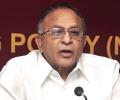
In his first interview after the announcement on Telangana, Jaipal Reddy spoke about the historical background of the movement, Narendra Modi and other issues.
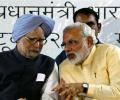
NDA under Mr Modi is as focused on the rural poor with doles and hand-outs as the UPA under Dr Singh was.

Manish Sisodia's elevation as Delhi CM would set Arvind Kejriwal free to take up a significant role in national politics, or he could return to activism, says Sudhir Bisht.

'It is extremely important to take back the domain of both religion from the religious bigots and nationalism from the chauvinists, who are spreading hatred.' Sugata Bose, the Harvard historian-turned-MP, who is Netaji's great-nephew, tells Anjali Puri why it is imperative to speak up for India's students.

'Knowing him personally, I can safely say that the usually soft-spoken, qualified medical doctor would not have said what he was 'caught' saying if only he had realised that he was stepping on a political landmine across the emotional LoC, says Mohammad Sayeed Malik.

'The only narrative before India is what Modi and the BJP is presenting.' 'Nationalism has been taken as a serious plank by the BJP and RSS.' 'They want to keep the nationalism thing alive to make people forget the economic reality.'

The Biju Janata Dal MP from Dhenkanal says crime will come down if cannabis is legalised.
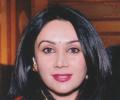
The petite princess is the newest catch of the Bharatiya Janata Party. The glamorous Rajkumari of Jaipur Diya Kumari is the third princess to join the saffron brigade.
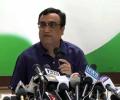
These chat show performers contribute to the noise, not clarity, says Mahesh Vijapurkar.
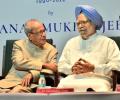
What Shekhar Gupta would have really liked to know from Pranabda: Why did Sonia prefer Dr Singh to him as PM? Why did he deny finance first, why did he accept it 5 years later, and why did he make such a mess of it? How did he force Sonia to nominate him for President and not Hamid Ansari? And how does he justify that most toxic legacy -- the Vodafone tax amendment?

By revising the India-Bangladesh land boundary agreement, the NDA is going for short-term gains and losing the long-term perspective, says Gautam Sen.
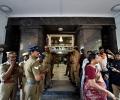
In private, AIADMK spokespersons say that the raid on Chief Secretary P Ramamohana Rao might be aimed at weakening the AIADMK, and demotivating the party from selecting/electing Jayalalithaa's confidante, Sasikala Natarajan, as her successor -- first as party head then possibly in the government, says N Sathiya Moorthy.

'No one talks about the Mumbai riots anymore, though like Delhi 1984, the guilty have not been punished. In Gujarat, many powerful leaders of the state's ruling party are in jail for their role in the riots... In Mumbai, only one politician of the Shiv Sena, a former MP, was convicted of hate speech, along with two other Shiv Sainiks, one of whom was a corporator and the other a junior functionary... So why the apathy? Could it be because despite these statistics and the widely-publicised findings of the Srikrishna Commission, what remained in public consciousness was the violence by the Muslims, thanks to a highly efficient Sena propaganda machine? There's no demand for it, but would an SIT probe into the closed cases of the Mumbai riots help today?' The fadeout of Mumbai's riots from public debate can be called a triumph of the communal State, argues Jyoti Punwani.

'If the dimensions of the strategic partnership worked out by India and the US seem like a grand alliance targeted at you-know-who, China had better realise that it has fathered it,' says B S Raghavan, a long time observer of China.
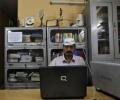
The Aam Aadmi Party (AAP) has to deal with 3 powerful enemies: the media, the political establishment, and business houses.

Atal Bihari Vajpayee would seek to placate the hawks in the RSS by stating that the writing of history should not be one-sided. At the same time, he would project a moderate 'Nehruvian' image of himself as the archetypal liberal politician who would strive to attain a balance between conflicting viewpoints. A fascinating profile of the former prime minister and Bharat Ratna by Paranjoy Guha Thakurta and Shankar Raghuraman.
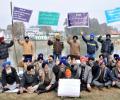
APSCC Chairman Jagmohan Singh Raina talks about the life and times of the Sikh minority in a politically tumultuous region of Jammu & Kashmir.
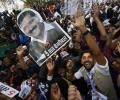
'I think the AAP is still in transition from being a movement to a political party so there is a mix of people who form the party. So there is somewhat of a overlapping and commonality of purpose.' 'Look at the way the government and party is functioning, not a single woman minister in the cabinet, or no woman member in the political affairs committee, it is all very tactical now.' 'After the 'sting' I decided to step back. I realised that my moral basis has been questioned by Kejriwal, it is truly despicable. He is around 15 years younger to me, I was aghast by his words.' AAP 'rebel' Prof Anand Kumar speaks of what went wrong with the party in the last few days in this interview with Upasna Pandey.

On the occasion of the first prime minister Jawaharlal Nehru's 125th birth anniversary, Sheela Bhatt/Rediff.com visits his residence of 16 years, and comes away marvelling at his enduring legacy.
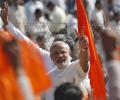
'A change of government will bring about a lot of changes because everything is frozen for the last two years. So, the frozen energies of India will be released.' Swadeshi Jagran Manch convenor Swaminathan Gurumurthy discusses the Modi phenomenon with Shobha Warrier/Rediff.com

Biometric authentication is based on the unscientific and questionable assumption that there are parts of human body that does not age, wither and decay with the passage of time.

'... A youth movement which could really transform our politics in a way that the existing elites don't understand.' 'The more you suppress free expression, the more people will value it.' 'The State can't suppress a young society like India where there are so many interesting new ideas emerging,' says Sunil Khilnani, whose latest book Incarnations looks at Indian history through 50 lives.

Mahesh Rangarajan, director of the historic Nehru Memorial Museum and Library in New Delhi, tells Sheela Bhatt how the first prime minister will always remain relevant, and the efforts being made to keep his legacy alive.
 © 2026 Rediff.com - Advertise with us - Disclaimer - Privacy Policy - Sitemap - Feedback - About us - Terms of use - Grievances